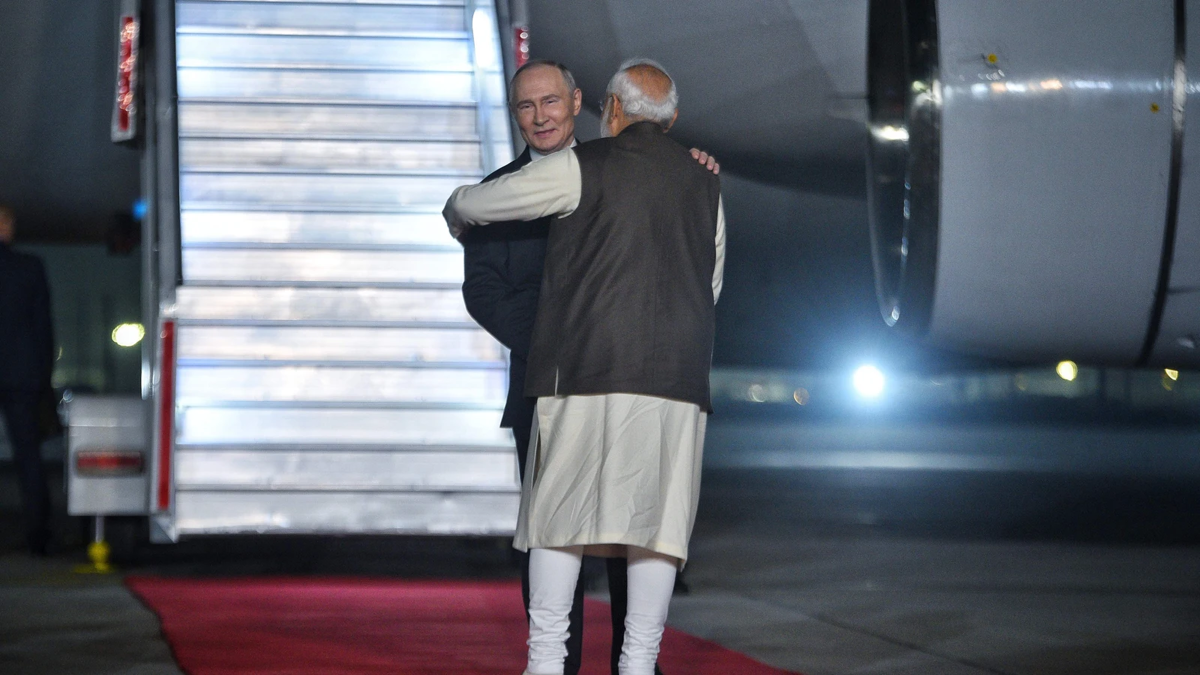
To understand the scene, one must understand India: the symbolic hug, in a culture where physical contact is reserved, was not a political endorsement of Moscow, but a way of showing that New Delhi makes decisions without conditioning, even in the face of the United States and Europe, its natural partners in democratic values, technology, and regional stability. India maintains a historical link with Russia dating back to 1947, when the USSR supported its strategic and industrial development without demanding ideological alignment. A strong, independent, democratic, and prosperous India is essential for global stability. A misunderstood or humiliated India can tilt geopolitical balances in unpredictable directions. New Delhi's message, expressed in a hug that went around the world, is clear: India cooperates with those who respect it and resists those who pressure it. However, what happened in India cannot be read as an anti-Western turn or an adherence to Russian authoritarianism: it is, above all, a firm reminder that the largest democracy in the Indo-Pacific does not accept tutelage, sanctions, or external pressure, and that its foreign policy continues to be guided by a historical and immovable principle: the absolute defense of its strategic autonomy. The gesture — unusual in the rigid Indian protocol, which is rarely altered — was interpreted in the West as a sign of closeness between Modi and Putin. India cannot abruptly break with Moscow, but it will not align with its global agenda either. The warmth of Putin's reception must be read under this light: a gesture of autonomy, not alignment. A reminder that India will not accept unilateral sanctions, will not allow interference in its energy decisions, and will not act as a 'wall' to contain China if it means losing freedom of action. New Delhi does not endorse that war, but it will not break a structural link that guarantees arms supplies, technological cooperation, and, above all, oil at reduced prices, a vital element for sustaining the growth of a 1.4 billion-person economy. This pragmatism deepened after what was experienced in India as an affront: President Trump's decision to impose secondary tariffs for the purchase of Russian crude. But New Delhi insists on a premise that the West still has difficulty grasping: India is a partner, not a subordinate. In India, where experience and seniority are pillars of legitimacy, gestures suggesting underestimation or a lack of diplomatic professionalism are not well tolerated. For a country extremely sensitive to hierarchical and diplomatic respect, the sanction was seen as an unnecessary humiliation. The effect was immediate: instead of pushing New Delhi away from Moscow, it reinforced the Indian need to demonstrate operational independence. Another error by Washington contributed to the climate: the appointment of an ambassador who was too young, with insufficient experience and perceived as favored due to personal ties with the presidential family. India wants to strengthen its own capacity to face Beijing and Islamabad, not become an instrument of third parties. In this convulsive world, where the balances of the Indo-Pacific will define the 21st century, the West must understand what India is saying: respect, cooperation, and partnership between equals. Modi knows—and his foreign ministry repeats it privately—that the current Russia is the aggressor in Ukraine. Its democratic system, market economy, large middle class, vibrant civil society, and its massive diaspora in Europe and the United States naturally align it with liberal democracies. These are not minor incidents: they are misread messages. Despite this current tension, India remains much closer to the West than to any authoritarian power. No more, but no less. France is advancing strongly—Rafale, Scorpène—and the United States is gaining ground in intelligence and naval cooperation, but replacing six decades of military infrastructure is not an immediate process. It does not believe in vertical alliances or the logic of permanent blocs; it believes in the national interest and balanced relations. In the military sphere, dependence on Russia remains significant: Su-30MKI fighters, T-90 tanks, BrahMos missiles, air defense systems, and much of its operational doctrine. That memory weighs, but it does not determine. Buenos Aires, December 8, 2025 – Total News Agency-TNA – Vladimir Putin's visit to New Delhi and the unusual gesture of Prime Minister Narendra Modi, who personally received him on the tarmac, set off alarms in several Western capitals. The West would do well to take note.